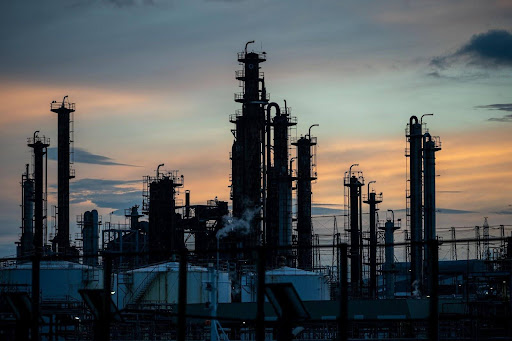
The Middle East energy crisis spread its economic tentacles further Thursday, hitting European gas markets and Asian stock exchanges as Iran’s military strikes continued to disrupt oil supply across the Gulf region. European natural gas prices climbed 7.7% for the second consecutive day, while Japan’s Nikkei fell 1.6% and South Korea’s Kospi shed 1.2%. Oil prices remained stubbornly near $100 a barrel as emergency supply measures struggled to offset the scale of disruption.
Iranian forces struck merchant ships near the Strait of Hormuz, fuel storage tanks in Bahrain, oil tankers near Iraq’s export ports, and a port near Oman’s Mina Al Fahal terminal. Three crew members aboard the Thai-registered Mayuree Naree were believed trapped following a ship attack. Iraq suspended crude exports and Oman cleared its main export terminal of vessels.
Brent crude gained about 6% to nearly $98 a barrel after briefly touching $100.29. West Texas Intermediate rose 8.6% to $94.75. The oil price has risen sharply from $60 at the year’s start, peaking at $119 earlier in the week. Iran’s military warned that oil could hit $200, arguing that US destabilization of the region is responsible for the price surge.
The IEA released 400 million barrels of emergency crude from 32 member nations — a record. The US separately announced a 172-million-barrel drawdown from its Strategic Petroleum Reserve, with delivery beginning within a week. Despite these efforts, markets remained unnerved by the prospect of a prolonged conflict.
Goldman Sachs raised its Q4 2026 Brent forecast to $71 per barrel. Deutsche Bank’s Jim Reid warned of a potential stagflationary shock. Without de-escalation, energy analysts say oil prices are likely to remain highly elevated.
European Gas and Asian Stocks Feel the Heat of the Middle East Energy Crisis