
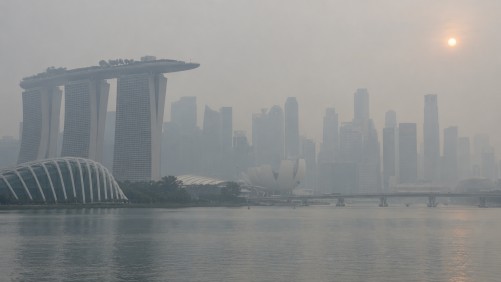
Singapore continues to grapple with unhealthy air quality levels as haze from nearby Indonesian regions blankets the city-state. On October 6, the Pollutant Standards Index (PSI) readings indicated unhealthy air conditions across most areas, with the central region recording the highest level at 130. The PSI, which measures a 24-hour average of air pollutants, designates readings from 101 to 200 as unhealthy.
The air quality issue stems from smoke drifting from Kalimantan and southern Sumatra in Indonesia, exacerbated by dry conditions that have led to moderate to dense smoke plumes. Fine particle pollution, measured as PM2.5, also showed elevated levels, with the central region reaching 60, the west 59, and the east 56. Only the southern part of Singapore reported a moderate PSI reading of 95 and a PM2.5 level of 35.
Authorities have warned that the haze may persist due to ongoing dry weather conditions, predicting that the PSI could remain in the high-moderate to mid-unhealthy range. The situation has worsened since September when the PSI first entered the unhealthy range, with the highest reading this year recorded at 164 in the central region on September 29.
The prolonged haze has sparked concerns about the potential for extended dry conditions, which could delay the onset of the wetter season in Southeast Asia. This delay is attributed to weather patterns associated with a strong El Niño, potentially lengthening the period of compromised air quality in Singapore.